The main difference between an inverting vs non-inverting amplifier is the phase relationship between the input and output signals. An inverting amplifier produces an amplified output that is 180° out of phase with the input, while a non-inverting amplifier produces an amplified output that remains in phase with the input.
Both configurations use an operational amplifier (op-amp) with negative feedback to achieve a controlled voltage gain. The choice between them depends mainly on the required gain, phase relationship, input impedance, and circuit application.
What Is an Op-Amp?
An operational amplifier, commonly called an op-amp, is a high-gain electronic device used to amplify and process electrical signals. It is widely used in analog circuits for applications such as voltage amplification, filtering, signal conditioning, addition, subtraction, integration, and differentiation.
A basic op-amp has two input terminals and one output terminal:
- Inverting input (-)
- Non-inverting input (+)
- Output
External resistors are commonly connected around the op-amp to provide negative feedback and control the closed-loop voltage gain.
Inverting vs Non-Inverting Amplifier Comparison Table
The following table summarizes the major differences between an inverting and a non-inverting amplifier.
| Parameter | Inverting Amplifier | Non-Inverting Amplifier |
| Input terminal | Inverting terminal (-) | Non-inverting terminal (+) |
| Output phase | 180° out of phase | In phase |
| Voltage gain | Negative | Positive |
| Gain formula | Av = -Rf/Rin | Av = 1 + Rf/R1 |
| Output polarity | Opposite to input | Same as input |
| Input impedance | Approximately equal to Rin | Very high |
| Minimum voltage gain | Can be less than, equal to, or greater than 1 | Always 1 or greater |
| Feedback | Negative feedback | Negative feedback |
| Virtual ground | Present at the inverting input under ideal conditions | The inverting input is at approximately the same voltage as the non-inverting input |
| Phase shift | 180° | 0° |
| Typical use | Signal inversion and controlled voltage amplification | Voltage buffering and non-inverting amplification |
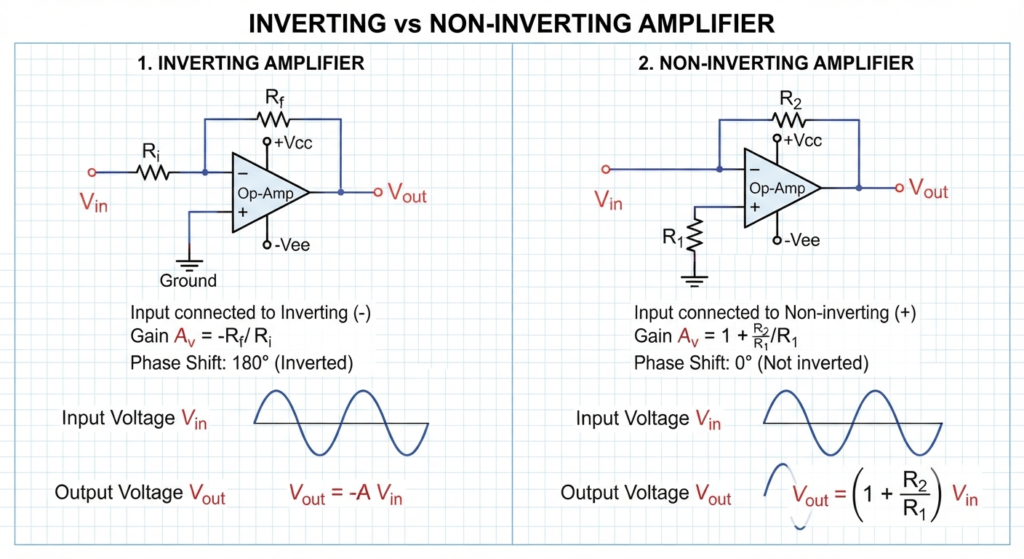
What Is an Inverting Amplifier?
An inverting amplifier is an op-amp circuit in which the input signal is applied to the inverting (-) terminal through an input resistor. The non-inverting (+) terminal is normally connected to ground for a conventional single-input configuration.
A feedback resistor, , is connected between the output and the inverting input. This negative-feedback arrangement controls the voltage gain of the circuit.
Because the input is applied to the inverting terminal, the output signal has the opposite polarity to the input signal. Therefore, the output is shifted by 180° relative to the input.
For example, when a positive input voltage is applied, the output tends to become negative. Similarly, a negative input produces a positive output, provided the amplifier operates within its output voltage limits.
Inverting Amplifier Circuit
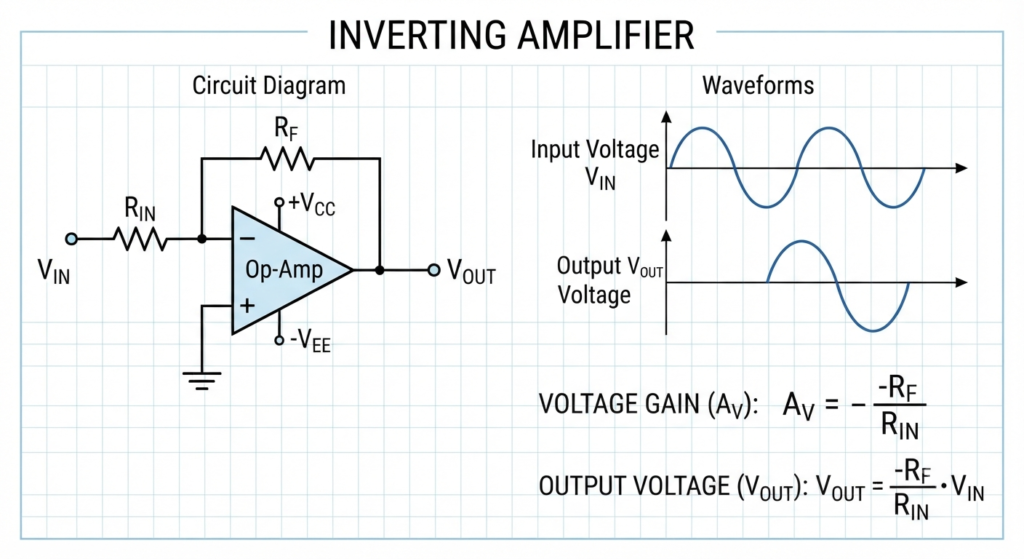
The basic arrangement contains:
- Input voltage
- Input resistor
- Feedback resistor
- Op-amp
- Ground connection at the non-inverting terminal
- Output voltage
The input signal reaches the inverting terminal through , while provides negative feedback from the output to the same terminal.
Gain of Inverting Amplifier
For an ideal inverting amplifier, the voltage gain is:
Therefore, the output voltage is:
The negative sign indicates that the output is inverted relative to the input.
For example, if:
and
then:
Thus, the output voltage is ten times the input voltage and has opposite polarity.
What Is a Non-Inverting Amplifier?
A non-inverting amplifier is an op-amp configuration in which the input signal is applied directly to the non-inverting (+) terminal.
The inverting (-) terminal receives a portion of the output through a resistor-feedback network. Negative feedback is used to establish a stable and predictable closed-loop gain.
Since the input is applied to the non-inverting terminal, the output remains in the same phase as the input. A positive input produces a positive output, while a negative input produces a negative output, within the operating limits of the amplifier.
Non-Inverting Amplifier Circuit
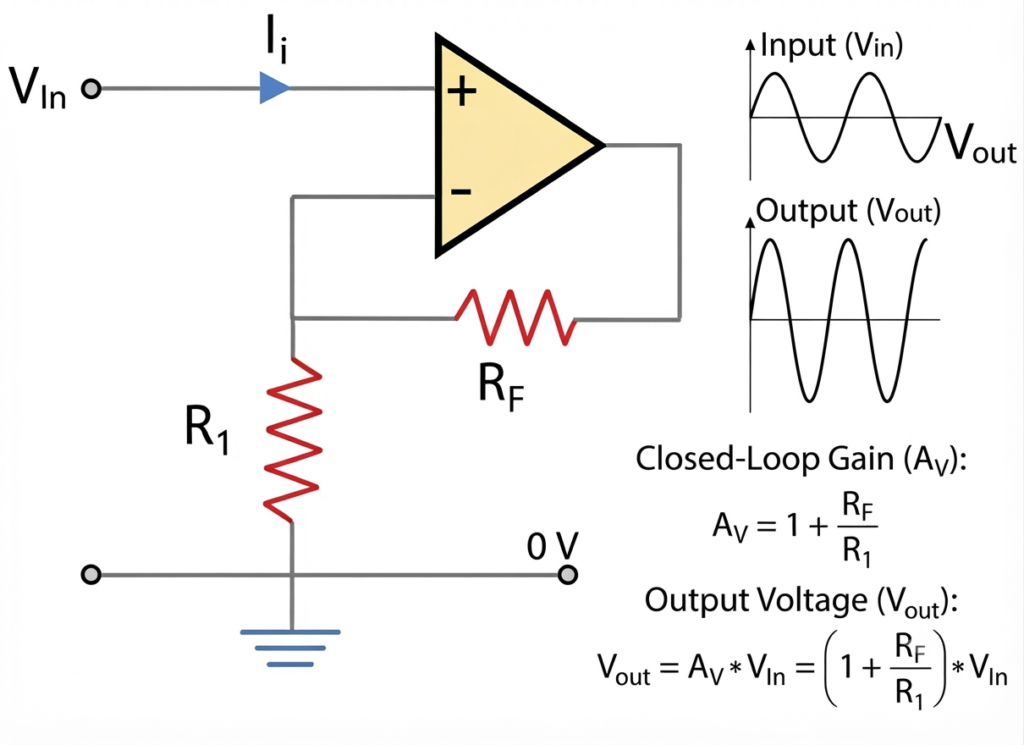
A typical non-inverting amplifier contains:
- Input voltage
- Resistor
- Feedback resistor
- Op-amp
- Ground connection at the non-inverting terminal
- Output voltage
The input signal directly drives the non-inverting terminal, while the feedback network connects the output to the inverting terminal.
Gain of Non-Inverting Amplifier
The voltage gain of an ideal non-inverting amplifier is:
The output voltage can therefore be expressed as:
For example, if:
and
then:
Therefore, the output voltage is 11 times the input voltage, assuming the op-amp remains within its linear operating range.
Key Differences Between Inverting and Non-Inverting Amplifier
1. Input Connection
The input signal is applied to the inverting terminal in an inverting amplifier.
In a non-inverting amplifier, the input signal is applied to the non-inverting terminal.
2. Phase Relationship
The most important difference between the two configurations is their phase relationship.
An inverting amplifier produces an output that is 180° out of phase with the input.
A non-inverting amplifier produces an output that is in phase with the input.
3. Voltage Gain
The voltage gain of an inverting amplifier is:
The voltage gain of a non-inverting amplifier is:
The negative sign in the inverting configuration represents phase inversion.
4. Input Impedance
The input impedance of an inverting amplifier is approximately determined by the input resistor:
A non-inverting amplifier has a very high input impedance because the signal is connected directly to the op-amp’s non-inverting input.
Therefore, a non-inverting configuration is useful when the source should experience minimal loading.
5. Output Polarity
The output of an inverting amplifier has opposite polarity to the input.
For example, a positive input produces a negative output for a positive gain magnitude.
In a non-inverting amplifier, the output retains the same polarity as the input.
6. Minimum Gain
An inverting amplifier can provide a voltage gain magnitude below 1, equal to 1, or greater than 1 depending on the relationship between and .
For a non-inverting amplifier:
Therefore, its voltage gain is normally 1 or greater.
7. Feedback Arrangement
Both configurations use negative feedback.
In an inverting amplifier, the feedback resistor connects the output to the inverting input, where the input signal is also applied through .
In a non-inverting amplifier, the feedback network is connected to the inverting input while the signal is applied to the non-inverting input.
8. Virtual Ground
In the conventional inverting amplifier, the non-inverting terminal is connected to ground. With negative feedback and an ideal op-amp, the inverting input is maintained at approximately the same voltage, creating what is commonly called a virtual ground.
In a non-inverting amplifier, the inverting input is not normally grounded. Instead, it follows the input voltage approximately because of the negative-feedback action.
Inverting vs Non-Inverting Amplifier: Gain Comparison
The gain equations are different for the two configurations.
For an inverting amplifier:
For a non-inverting amplifier:
Consider a circuit where:
and
For the inverting amplifier:
The output is therefore amplified by a factor of 20 and inverted.
If the same resistor values are used in a non-inverting configuration:
The output is amplified by a factor of 21 and remains in phase with the input.
Applications of Inverting Amplifier
Inverting amplifiers are widely used in analog electronic circuits where signal inversion or a controlled gain is required.
Common applications include:
- Signal amplification
- Signal inversion
- Audio circuits
- Analog signal processing
- Active filters
- Summing amplifiers
- Signal conditioning
- Digital-to-analog converter circuits
- Mathematical operations using op-amps
The inverting configuration is particularly useful for circuits where several input signals need to be combined because multiple input resistors can be connected to the same inverting node.
Applications of Non-Inverting Amplifier
Non-inverting amplifiers are commonly used when a signal needs to be amplified without changing its phase.
Typical applications include:
- Voltage amplification
- Sensor signal conditioning
- Buffer circuits
- Audio amplification
- Measurement systems
- Instrumentation circuits
- Active filters
- Data acquisition systems
- Interface circuits
The very high input impedance of the non-inverting configuration makes it useful for amplifying signals from sources that cannot supply significant input current.
Inverting vs Non-Inverting Amplifier: When to Use Which?
The choice between an inverting and non-inverting amplifier depends on the requirements of the circuit.
An inverting amplifier can be selected when:
- The output needs to be 180° out of phase with the input.
- A gain below unity is required.
- Multiple input signals need to be summed.
- The input impedance can be determined by an external resistor.
- Signal inversion is required as part of the circuit function.
A non-inverting amplifier can be selected when:
- The output must remain in phase with the input.
- High input impedance is required.
- The signal source should experience minimal loading.
- A voltage gain of one or greater is required.
- The circuit is being used as a voltage buffer or signal-conditioning stage.
Similarities Between Inverting and Non-Inverting Amplifier
Although their input connections and phase relationships are different, both configurations have several similarities.
- Both use operational amplifiers.
- Both normally use negative feedback.
- Both provide controlled closed-loop voltage gain.
- Both use external resistors to establish gain.
- Both can amplify analog signals.
- Both are widely used in signal-conditioning circuits.
- Both operate linearly when the op-amp remains within its specified limits.
- Both can be designed using ideal op-amp assumptions for basic analysis.
Advantages of Inverting Amplifier
Some important advantages of the inverting configuration are:
- Simple circuit design.
- Easy control of voltage gain.
- Gain can be less than unity.
- Output phase inversion is predictable.
- Multiple input signals can be combined.
- Useful for summing and signal-processing circuits.
Advantages of Non-Inverting Amplifier
Important advantages of the non-inverting configuration include:
- Very high input impedance.
- No phase reversal.
- Simple gain calculation.
- Suitable for voltage buffering.
- Useful for sensor and measurement signals.
- Causes relatively little loading of the signal source.
Conclusion
The comparison of Inverting vs Non-Inverting Amplifier shows that both are important op-amp configurations, but they differ mainly in input connection, voltage gain expression, input impedance, and phase relationship.
An inverting amplifier applies the input to the inverting terminal and produces an output that is 180° out of phase with the input. Its voltage gain is determined by the ratio of the feedback resistor to the input resistor:
A non-inverting amplifier applies the input to the non-inverting terminal and produces an output that remains in phase with the input. Its voltage gain is:
In simple terms, an inverting amplifier changes the phase of the signal by 180°, whereas a non-inverting amplifier preserves the phase of the signal. The appropriate configuration depends on the required gain, input impedance, phase relationship, and intended application.
Frequently Asked Questions
The main difference is the phase relationship between input and output. An inverting amplifier produces an output that is 180° out of phase with the input, whereas a non-inverting amplifier produces an output that is in phase with the input.
The voltage gain of an ideal inverting amplifier is: .The negative sign shows that the amplifier reverses the phase of the output signal by 180° relative to the input.
The voltage gain of an ideal inverting amplifier is:
Therefore, the gain is positive and the output remains in phase with the input.
The non-inverting amplifier provides very high input impedance because the input signal directly drives the op-amp’s non-inverting terminal.
Yes. The magnitude of the gain can be less than 1 when the input resistance is greater than the feedback resistance.
Read Next: