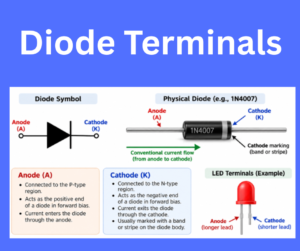
Diode Terminals: Anode and Cathode Explained
A diode is a two-terminal semiconductor device with two ends called the anode and cathode. These terminals determine how the diode is connected in a
A diode is a two-terminal semiconductor device with two ends called the anode and cathode. These terminals determine how the diode is connected in a
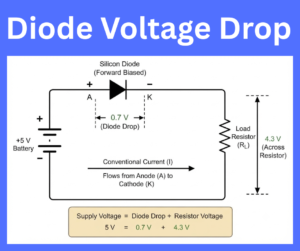
Every diode has a diode voltage drop when it conducts current. This voltage loss affects how much voltage reaches the load, how much power the

Learn how a Zener diode works as a voltage regulator, its circuit design, working principle, and applications in maintaining a stable output voltage A Zener

Zener diode applications are widely seen in electronic circuits for voltage regulation, meter protection, wave shaping, noise reduction, overvoltage protection, voltage reference, temperature sensing, and

Zener diode ratings refer to the electrical characteristics and operational limits defined by manufacturers in the datasheet or nameplate of the component. These ratings help

Zener diode current ratings include IF (Forward Current), IFRM (Repetitive Peak Forward Current), IZM (Maximum Zener Current for continuous operation), and IZSM (Surge Zener Current

Zener voltage (VZ) is the breakdown voltage at which a Zener diode conducts in reverse bias, maintaining a stable voltage despite current variations, making it

The main difference between TVS diode and Zener diode is that TVS diodes protect circuits from transient voltage spikes, while Zener diodes regulate voltage by

The softness factor of a diode indicates the sharpness of its reverse recovery characteristic. A lower value signifies an abrupt recovery, while a higher value

A TVS diode (Transient Voltage Suppression diode) is a semiconductor device designed to protect electronic circuits from voltage spikes by clamping excessive voltage and diverting