A diode is a two-terminal semiconductor device with two ends called the anode and cathode. These terminals determine how the diode is connected in a circuit and the direction in which conventional current can flow.
Anode and Cathode of a Diode
A diode has two terminals: the anode and cathode. The anode is connected to the P-type region, while the cathode is connected to the N-type region. When the diode is forward-biased, the anode is at a higher potential than the cathode, allowing conventional current to flow from anode to cathode.
The anode and cathode are present in different types of diodes, including Zener diodes, Schottky diodes, LEDs, photodiodes, and PIN diodes. However, the physical method used to identify these terminals may vary with the diode type and package.
Correctly identifying the diode terminals, polarity, and cathode marking is important for making proper circuit connections and preventing component damage.
How to Identify Diode Terminals
Identifying the anode and cathode of a diode is important before connecting it to a circuit. In many commonly used through-hole diodes, a band or stripe on the body indicates the cathode terminal.
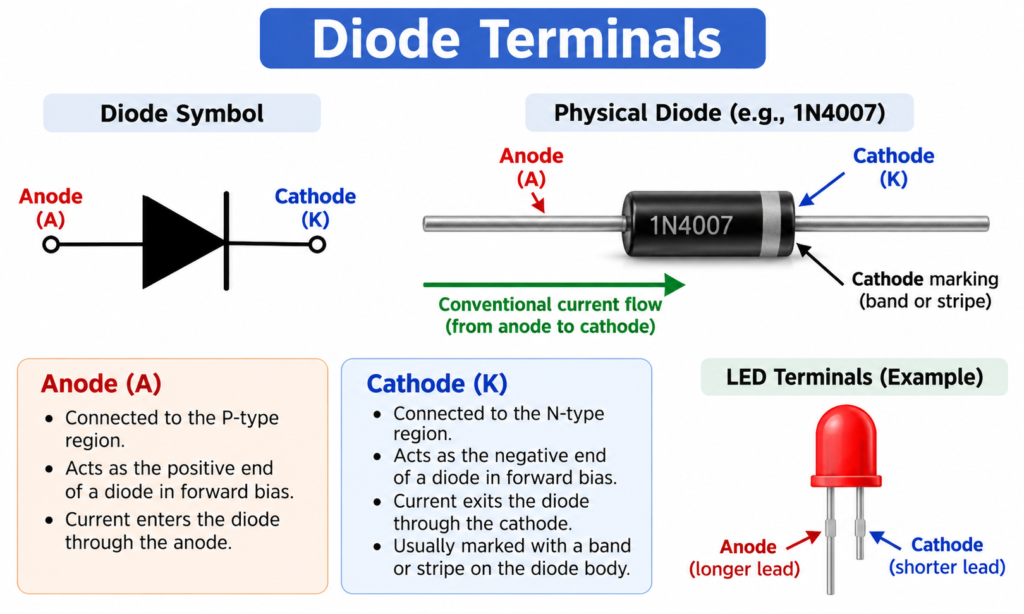
For example, in a typical rectifier diode such as the 1N400x series, the marked end is the cathode, while the unmarked end is the anode.
The cathode can also be identified from the circuit symbol. The bar in the diode symbol represents the cathode, while the opposite side represents the anode.
The terminals of an LED (Light-Emitting Diode) can be identified by examining its leads and body. In a typical through-hole LED, the longer lead is the anode, while the shorter lead is the cathode. The flat edge on the LED body usually also indicates the cathode side.
For a new LED with its leads uncut, the longer lead provides a quick way to identify the anode (positive terminal). If the leads have already been trimmed, the flat edge of the LED body can help identify the cathode (negative terminal).
Diode Polarity
Diode polarity determines whether the device is forward-biased or reverse-biased.
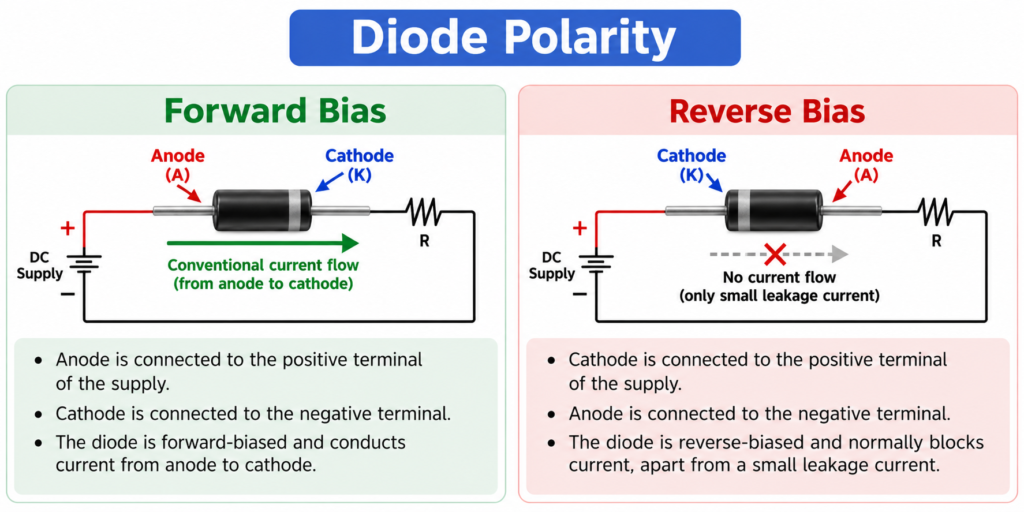
When the anode is connected to a higher potential than the cathode, the diode is forward-biased and allows conventional current to flow from the anode toward the cathode.
When the cathode is at a higher potential than the anode, the diode is reverse-biased and normally blocks current, apart from a small leakage current.
Conclusion
A diode has two terminals, the anode and cathode, which determine its polarity and current flow. The anode is connected to the P-type region, while the cathode is connected to the N-type region. Correctly identifying these diode terminals is essential for proper circuit connection, especially when working with different types of diodes such as rectifier diodes, Zener diodes, and LEDs.
Read Next:
- Schottky Diode vs Zener Diode
- Difference Between BJT and MOSFET
- Difference Between Diode and Rectifier
- Difference Between Diode and Transistor
- Difference Between Silicon Diode and Germanium Diode
- Diode Voltage Drop: Formula, Values, Chart, Table & Measurement
- Diode Turn-On Voltage: Definition, Values & Examples
- Diode Symbol: Meaning, Types, Circuit Examples