Light plays a vital role in our everyday lives. It allows us to see, communicate, and even perform advanced medical procedures. However, not all light is the same. There are two primary types of light — ordinary light and laser light. Understanding the difference between ordinary light and laser light is important for both scientific and practical applications.
Both ordinary light and laser light are forms of electromagnetic waves, which means they travel at the same speed in a vacuum — the speed of light. The main distinction is that ordinary light is a mixture of different wavelengths, while laser light is monochromatic, consisting of a single wavelength. This unique property gives laser light its high intensity, directionality, and coherence.
In this article, we will explain what laser light is, reveal the full form of laser light, explore the types of laser light, and provide a detailed comparison with ordinary light. You will also find a comprehensive table summarizing all the key differences between ordinary light and laser light.
What is Ordinary Light?
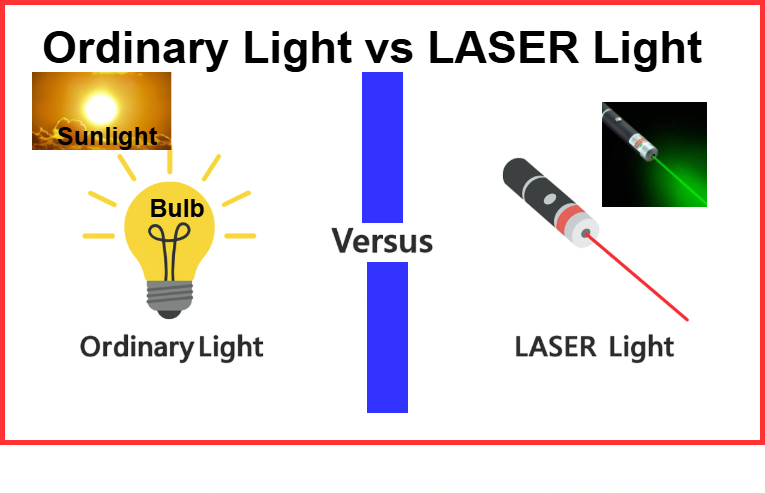
Ordinary light (also called natural or incoherent light) comes from everyday sources like the sun, electric bulbs, and candles.
This type of light consists of many colors and wavelengths mixed together. The light waves are random and travel in different directions, which is why ordinary light spreads out and appears soft.
Key features of ordinary light:
- It is incoherent, meaning the waves are not in phase.
- It has many wavelengths and colors.
- It spreads in all directions.
- Its intensity is low compared to laser light.
- Common examples include sunlight, lamp light, and flashlights.
What is Laser Light?
The word LASER stands for Light Amplification by Stimulated Emission of Radiation.
Laser light is different from ordinary light. It is coherent, monochromatic, and highly directional. This means all the light waves move in the same direction, at the same frequency, and in perfect phase.
Laser light is created through a special process called stimulated emission, where excited atoms release photons in a synchronized manner. Because of this, laser beams are powerful, focused, and capable of traveling long distances without spreading.
Key features of laser light:
- It is coherent — all waves are in phase.
- It is monochromatic — has a single wavelength.
- It is highly directional and focused.
- It has very high intensity and energy concentration.
- Examples include Helium-Neon lasers, CO₂ lasers, and semiconductor lasers.
Full Form of Laser Light
The full form of laser light is:
LASER – Light Amplification by Stimulated Emission of Radiation.
This means laser light is produced when atoms or molecules are excited and then emit photons in a controlled and amplified manner. This process gives laser beams their powerful and focused nature.
Types of Laser Light
There are different types of laser light depending on the medium used to produce it.
| Type of Laser Light | Active Medium | Example | Common Applications |
| Solid-State Laser | Solid crystal (e.g., Ruby, Nd:YAG) | Ruby Laser | Metal cutting, medical use |
| Gas Laser | Gas mixture | CO₂ Laser, He-Ne Laser | Welding, barcode scanners |
| Semiconductor (Diode) Laser | Semiconductor materials | Laser Diode | CD/DVD players, fiber optics |
| Liquid (Dye) Laser | Organic dyes in solution | Rhodamine Laser | Scientific research |
| Fiber Laser | Optical fiber doped with rare-earth elements | Ytterbium Fiber Laser | Industrial cutting, marking |
Each type of laser has its own specific use, depending on power, wavelength, and precision requirements.
Applcations of Laser Light
Laser light has become a vital part of modern technology. Its precision and power make it useful in various areas:
- Medical field: Eye surgery (LASIK), dental treatment, and skin therapy.
- Industrial use: Metal cutting, welding, and engraving.
- Telecommunication: Data transfer through fiber optics.
- Scientific research: Holography and spectroscopy.
- Defense and security: Range finding, target designation, and weapon systems.
Difference Between Ordinary Light and Laser Light
The following table highlights the difference between ordinary light and laser light in simple terms:
| Basis of Difference | Ordinary Light | Laser Light |
| Definition | Light containing a mixture of different wavelengths. | Light produced by stimulated emission with a single wavelength (monochromatic). |
| Emission Type | Spontaneous emission of photons. | Stimulated emission of photons. |
| Color / Chromaticity | Polychromatic — multiple colors. | Monochromatic — single color. |
| Frequency Range | Wide range of frequencies. | Very narrow frequency range. |
| Nature | Incoherent and random; occurs naturally. | Coherent and uniform; induced by stimulated emission. |
| Direction / Directionality | Divergent, spreads randomly in all directions. | Highly directional and focused. |
| Coherence | Incoherent, waves out of phase. | Coherent, waves in phase. |
| Coherence Length | Short, typically a few millimeters. | Very long, can extend to several kilometers. |
| Traveling Distance & Duration | Travels short distances; intensity decreases quickly. | Can travel long distances with minimal loss of intensity. |
| Intensity | Low, spreads out quickly. | Very high, concentrated energy. |
| Spreading | Spreads widely over large areas. | Minimal spreading, stays in a narrow beam. |
| Consistency | Inconsistent; photons vary in frequency. | Consistent; photons of the same frequency. |
| Focus | Cannot be focused sharply due to divergence. | Can be focused to a sharp point because of directionality. |
| Eye Safety | Generally safe under normal conditions. | Can damage eyes if directly viewed. |
| Energy Concentration | Distributed across a wide area. | Concentrated in a narrow area; high energy density. |
| Applications | General illumination, reading, lighting of rooms. | Metal cutting, welding, fiber optics, medical surgeries, printing, industrial and scientific use. |
| Practical Example | Sunlight, bulb light, candle light. | He-Ne laser, CO₂ laser, laser diode, fiber laser. |
Conclusion
The difference between ordinary light and laser light lies mainly in coherence, wavelength, and direction. Ordinary light is scattered and multi-colored, while laser light is focused, single-colored, and extremely powerful.
Understanding what laser light is, its full form, and the types of laser light helps us appreciate how this technology powers applications in medicine, communication, and industry.
Laser light is not just illumination — it’s innovation in action.
Related Articles: